From the “Judges View” by Debi van Wyk
In this series we are going to look at some judges tips on how to increase your scores in your dressage tests.
We will start with a few tips to work on before the actual tests.
The most important thing to mention is that the horse’s training is as per the training scale.
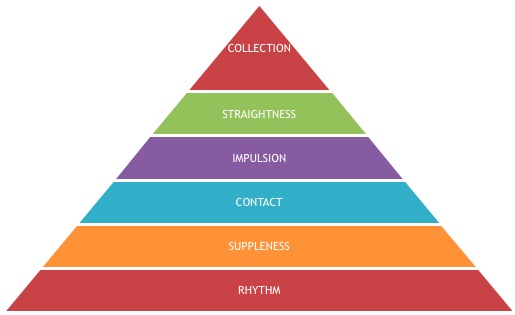
There are 3 phases in the training scale.
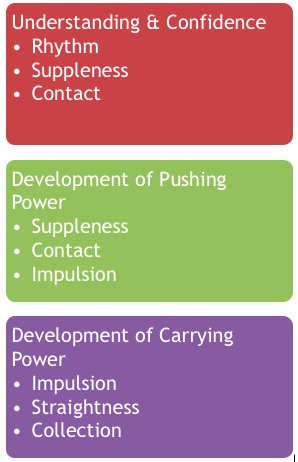
Our overall aim is to ensure that the horses are through from behind to the front – not front to back.
The horse is through when it allows the riders aids from back to front, thus achieving suppleness and impulsion.
- Practise riding tests at home. If your horse anticipates, break up the movements or ride the test backwards. It is very important to practise running through the movements in sequence to be able to keep your horse relaxed and focused and for you to get used to the speed at which the movements happen. It’s very different to training where you can do a transition etc. when it feels correct and you have the correct preparation. Having to execute movements at specific markers is a whole different ball-game.
- Know your test, do not rely on a caller. Have an understanding of the rules and errors of course. These maybe downloaded from the Dressage South Africa website:
(http://www.dressagesa.com/wp-content/uploads/2013/07/Dressage-SA-National-Dressage-Rules-2014.pdf) - Corners, transitions and half halts are your best friends.
- It’s important to ride corners well as it helps us create more power through increased engagement, maintaining rhythm and improving the horses balance. Corners are the preparation for subsequent movements, e.g. lengthen trot/canter.
- If we don’t ride good corners, our horse can dive over the inside or outside shoulder, we can lose rhythm and impulsion or our horse will shorten his stride and rush through, leaving the corner on the forehand and thus loosing preparation and balance for the next movement.
- In Prelim and Novice the corners are not ridden as deeply as in the more advanced tests, as the horses are not yet strong or balanced enough to create the engagement needed for deep corners.
- For the Prelim and Novice horse think of corners as quarter circles. This will keep your fluency and rhythm.
- There are 3 steps to riding a correct corner: a small quick half halt before the corner, riding forward through the corner (from your inside leg towards your outside hand, which will engage the horses inside hind leg) and then a rebalancing half halt on exiting the corner. This will ensure the horse is balanced, straight and prepared for the next movement.
- Transitions are the difference between gait e.g. walk to trot, trot to canter, canter to walk etc. But there are also transitions within the gaits e.g. medium trot to extended trot, extended canter to collected canter etc.
- The half halt is the most important aid and is necessary to ride all movements if you are to successfully influence the horse with invisible aids. You need it the most before you do anything else as the half halt is first to tell your horse “listen, something is changing and coming, sit on your hind legs and balance to be ready for me to ask it,” For example, the horse can’t do a good shoulder-in if you don’t prepare it in the corner, sitting him back with a half-halt.
- A half-halt will not work if the rider is not in a balanced position on the horse and will be particularly ineffective if the rider is tight and cannot feel what the horse is doing. So the horse will not feel the action of the rider’s back and gets strong into the rider’s hand.
- Half halts are normally executed in preparation for a transition.
- The half-halt in dressage is the balancer, the reinforcer, the reminder, the rejuvenator, the engager, and the tool to draw the horse’s attention back to work.
- The major role of the half-halt in dressage is to refine the transitions and the half-halt should not be used in a way that it keeps the horse behind the bit.
- According to Carl Hester “the half-halt is a bracing of the back, a halt and release that must be made within a stride and for the elite rider made completely invisible.
- A rider with an effective half-halt will execute a moment where they will stop/start without losing the forward impulsion and frame,” he said. “A half-halt should be completed in half a stride”.
Ingrid Klimke says “close your legs to engage the hind legs of the horse and step more under the centre of gravity, then close both fists, not hold against the horse, just close them.” - Yet, we still see many riders who instead of perfecting the half-halt with their seat, pull on the reins, shortening the horse’s neck more and more until he submits to being pulled around the dressage arena.
- Nuno Oliveira didn’t use the term half-halt, but knew that the rider must learn over time to use their seat, back, breathing, and feeling, to guide the horse. “Use hands and legs sparingly, and maintain balance through the seat”.
- To establish the art of lightness, one must be able to maintain and balance that lightness with an effective and subtle half-halt, and until the rider can effectively carry out this process, well: “No half-halt, no dressage!”
Now we will look at some important points to adhere to in the warm-up arena:
- Pass left shoulder to left shoulder.
- When riding at a slower pace, take the inside track thus allowing horses at a faster pace the outside track.
- When removing boots, adjusting tack, drinking water, talking to trainer etc. do this outside of the arena.
- It’s considered bad form for your trainer to be in the arena.
- Bridle numbers are to be on the left hand side of your horse, either on the bridle or numnah.