Archive by Author

Into Elementary – It’s not what Sherlock had in mind! ~ Brigitte Billings

If you’ve been stuck in Novice for a decade, you might be inclined to ask why they call it Elementary when it seems so hard to graduate to this level. It’s possibly because unless you’ve established the basics in Novice, the Elementary tests may seem filled with intimidating new work. But the truth is all of these movements have their foundations in your earliest training. Your horse’s strength, balance and response to your aids should result in a simple transition to this more demanding work.

 Up a notch

One of the first things you’ll notice is that things start to move a bit faster – where you may have had a full length of arena to lengthen a canter, now you’ll be expected to execute two or three movements in the same space. This will characterise your rise through the grades – each new level puts greater emphasis on the degree of communication and response to the aids; it’s the ultimate test of how well you and your horse can ‘speak’ to each other.

Interestingly, even if you reach the highest levels of dressage, it will still be the basics that underpin the most advanced movements. And if you don’t believe this, watch a Grand Prix test and see how much attention is paid to a simple rein-back.

The tests

As in Novice, there are seven Elementary tests – 1, 2, 3, 4, 5, 6 with a Freestyle and you now have the option of using a snaffle or a simple double bridle. Whip and spurs if required. Note, it is only from Elementary that rules dictate use of a dressage saddle, so you may have been performing quite happily in a GP until now. You’ll probably appreciate it, since now you’ll be riding your tests in sitting trot!

Again, judges will be paying attention to your horse’s rhythm, straightness and balance, along with cadence, elasticity, suppleness and engagement. While your horse’s self-carriage was tested in the ‘stretchy’ trot in Novice, in Elementary you’ll test it by giving the rein on a 20m circle in the canter.

The work you introduced in Novice will now be developed further. The subtle counter canter you rode on the curve through X will now be ridden on a 20m circle followed by a simple change of leg, testing your horse’s suppleness and obedience to the canter aid. You’ll also start to ride 10m canter half circles – the next step in your journey to the canter pirouette and a true test of your horse’s strength and balance. You’ll help him in his understanding of the concept when you start working on the turn on the haunches, which, along with the rein-back will develop his ability to collect and activate his hind leg. This will be useful as you start to ride collected gaits.

 Can your horse cope?

If you’re serious about keeping your equine athlete happy and working well – and let’s face it who isn’t – you’ll have noticed that it’s not enough to simply practice your flatwork every day. Your horse may benefit from cross-training to help build fitness and develop muscle power – hacking out, hill work and pole work can all help. Dressage may seem sedate but it actually requires incredible levels of strength and stamina.

Also, depending on your horse’s age and conformation, you may need to enlist the help of various specialists to keep him strong and sound. Farriers, vets, physios and other equine body workers can all play a role as you begin to learn that successful competing sometimes requires a team effort. As you become more finely attuned to how your horse’s body moves, you’ll realise that there are times that he could be performing more happily. Consider your own discomfort if you were attempting lateral work with a pinched nerve or misaligned spine – sometimes just the discomfort of simple muscle strain can cause resistance. Definitely a good reason to call in an expert, and even learn some maintenance skills yourself. Yet another way to bond!

Ready to upgrade?

You will advance through the grades by accumulating points at shows. From Novice to Elementary Medium, points are accumulated in the following way:

55% to 59% – 1 point

60% to 64% – 2 points

65% to 69% – 3 points

70% to 74% – 4 points

75% and above – 5 points

Your horse will be required to attain a minimum of 10 points and a maximum of 100 points to move up – this means that you can spend a little longer in a grade if you’d like more time to establish your work at that level.

 Next month we’ll look at the Elementary-Medium classes.

Want to try it out? Recreational membership is free! Visit www.dressagesa.com for contact information.
dsa-logo-play2


Getting to know your Grooms ~ Sikhangele Mbambo

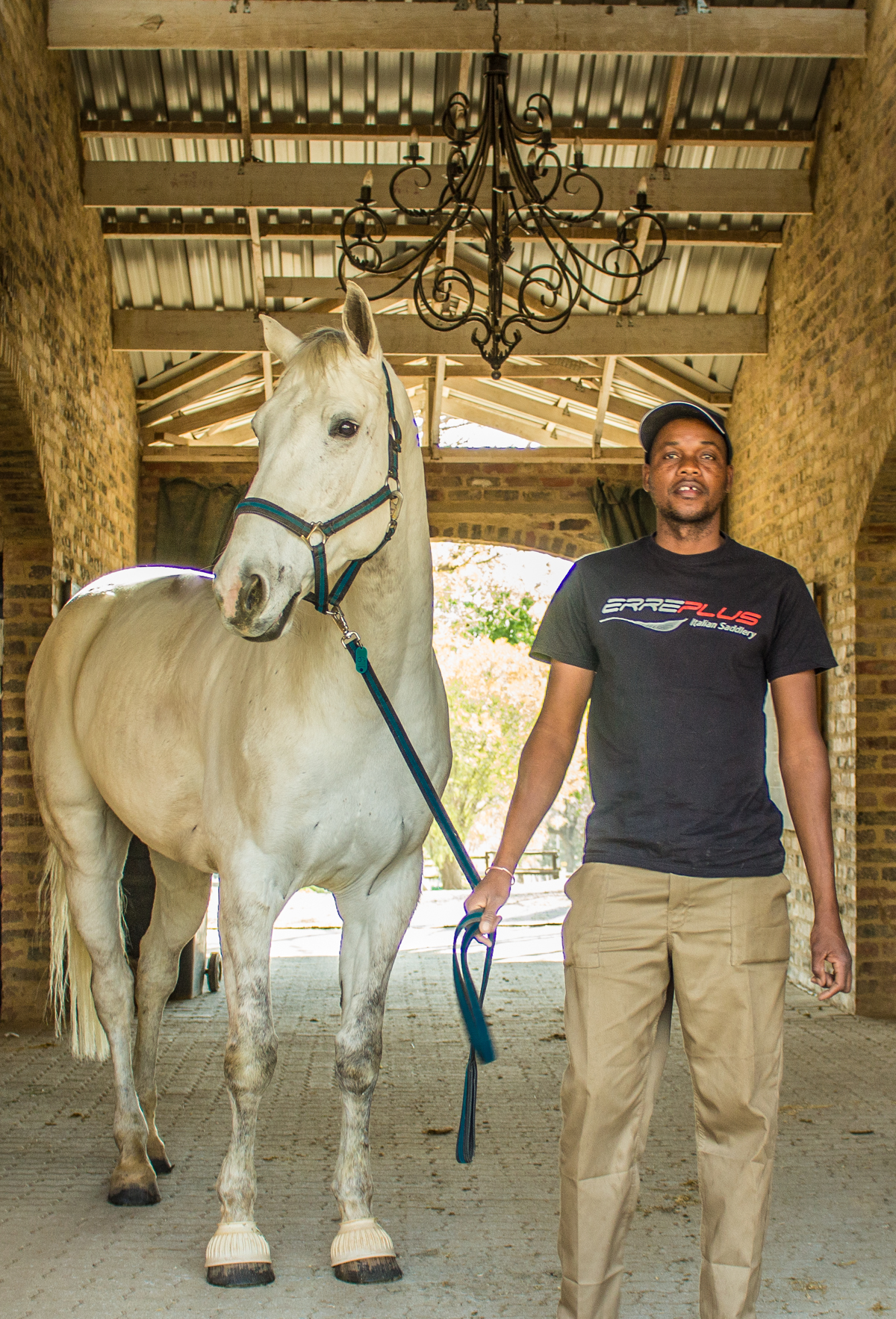
We had the pleasure of meeting with one of Burlington’s favorite grooms Paul Sizakele Ngubeni. One thing one can say about this animated gentleman is that he absolutely loves his charges and thoroughly enjoys his job. Like a parent with a favourite child he has a soft spot for Midgard Zingaro owned by showjumper Carolyn Chelchinskey. And like the favourite child that he is Zingaro hurt his groom on the left arm once, was forgiven and remains forever loved.

img_3843

Paul and Zingaro


Tell us a bit about yourself.

I am 42 years old, from Zimbabwe but I have had S.A citizenship for the past 15 years. My wife, who stays with me here at Burlington, works in Fourways.We have two children, a girl who is 13 and a boy, 8. They stay in Zimbabwe with their grandmother.

And grooming, how did you get into it?

My brother got me into grooming after the company where I was working closed down. I used to be a supervisor at Indimex, we exported dried tomatoed from making outfit in Musina. He then called me down and got me a job as a groom at Linbro Park.

And now you are at Burlington….?

Yes, I worked for 2 years in Linbro park at Byerely Stables and then l moved to Sunlands and became a groom for Claudia Dvrettas for 6 years after that. I loved it there but I couldn’t stay with my wife so I started looking for a job where I would be able to stay with her. Anne-Marie took both of us in and we have been here ever since. That was seven years ago.

Describe a your typical day as a groom.

I wake up at 5am daily, bath and put on my work suit. I drink my special ZCC tea, a whole 2l. At 5:50am I clock in at the stables. I open the 6 stables that I am in charge of, wash the water buckets refill the water and grass. I check on the well being of my horses and note their temperature . If any of them seem unwell I tell the manager, David Wilken or Anne-Marie. All this takes me till 7:45. From 8 – 9 I go for my own breakfast. After that I dress them all up in their fly sheets, fly masks and put on their paddock boots. Then I take them out to their paddocks and come back to clean the stables. At 11:00 I bring all my horses in. All those on medication are dosed and then I feed them their different foods.Zingaro (came from Namibia) who is about 4 yrs old for instance eats Epol Gold cup (1scoop) and Cosmo rider cubes. After all the horses are fed, given their lucerne, bran and watered, its time for my lunch. It runs from12:30 till 2 :30 then I come back and check the water again and on the horses. From then it’s grooming for all of them till about 4pm. I fill up on grass, check the water again (horses hydrated much? ☺) , give them their evening meal from 4:50pm and settle them down for the night. If I am on night duty (which he loves as it brings in extra cash) then I check on the horses after hours to make sure that they are all fine.

Do you ride?

No ways, I fell off a donkey when I was young and I will never get on another animal again hahahaha.

What are your plans for the future?

I am happy as a groom, I have done well for myself so much that I even have my own car. One day I will get a truck driver’s licence and drive the big Burlington truck full of horses to shows. (Does anyone else want to be Anne-Marie’s groom? )

How do you tell if one of your horses is not well?

There are so many signs to pick from. A horse will paw the ground, absence of droppings, food and water not touched or a horse just lying down. It’s important to keep the horse’s temperature checked. I alert the manager quickly so that action can be taken quickly.

Any show experience.

Yes and I love going to shows. I have been to Shongweni , Bloberg and lots of other venues. Blouberg is my favourite as it has really nice clean toilets and hot showers. We sleep in the truck when we are away mostly. It’s fun to meet other grooms from all over and exchange stories.

How would you describe a good groom?

Know your horse, know the signs of a healthy horse. Be patient, talk to your horse, be gentle and gain the trust of your horse so that your horse is comfortable with you.

What advice do you give your clients before they compete?

Be brave but cautious , make sure the horse is warmed up enough and do not rush. I remember once telling that to Debbie Last when she was competing with Picture at Shongweni and they won.

Do you think some types of food affect horses’ behaviour?

Definitely. Epol Gold Cup gives them energy

How do you prepare your horses for shows

I am always careful about saddle marks. I use Palmolive Aloe Vera shampoo, Trident mane and tail detangler. I make sure they are well plaited and well groomed .For flies I always use Quadrepel, it works best. No, I do not rotate fly repellents.

How do you think the lives of grooms can be improved?

Grooming is a dangerous job, it would help if grooms had medical aid and life policies.

Would you own a horse it you could afford it?

Definitely, my son would ride it and jump it. The girl is too shy, she would never get on a horse